• Home🏠
  • Podcast 🎧
  • eMail Subscription📫
  • Français🇫🇷
  • About ℹ️
  • Contact Us 📞
Menu

GraceNotes

  • Home🏠
  • Podcast 🎧
  • eMail Subscription📫
  • Français🇫🇷
  • About ℹ️
  • Contact Us 📞

Answering the Question

January 20, 2022

The accolades descend like tickertape. The headlines trumpet “talent,” “breakthrough innovation,” even “genius.” The penthouse suite no longer holds his new-found friends, who wait for selfie moments with the star. But in his heart of hearts he asks, “Am I really loved for me?”

Her performance brings the critics to their knees. “A soaring voice,” “a perfect portrayal of opera’s most tragic heroine,” “a triumph,” “a revelation.” But when the final curtain call is done and all the great reviews are folded, she wonders, “Am I really loved for me?”

It’s the question that never goes away—a deep uncertainty lingering beyond the money, power, skill or fame. And even well-meant promises from lovers, colleagues, friends and crowds don’t fill the emptiness within.

Jesus says, “I have loved you just as My Father has loved Me” (Jn 15:9). “God was in Christ, reconciling the world to Himself, no longer counting people’s sins against them” (2 Cor 5:19). “God proves His love for us in that while we were still sinners Christ died for us” (Rom 5:8).

We never tire of learning that we’re loved—at our best, at our worst; in our doing—and undoing. We may be brilliant, broken, blessed or bruised, but “with Him there is no alteration or shadow caused by change” (James 1:17).

The old song urged, “The gospel in a word is ‘love.’” Hear that melody again, and let yourself believe. 

And stay in grace.

Comment

Fixing What's Broken

January 12, 2022

If it were up to us, we’d save the world with money—lots of money—distributed to give each person food to eat and shelter from the storms.

If it were up to us, we’d save the world through education—teaching children how to read, filling schools and universities—for knowledge has advantages.

If it were up to us, we’d save the world by banning war—undoing arsenals, dissolving armies, teaching skills of compromise.

All these are good: we’ve tried them all. Yet still we wrestle—endlessly—with poverty, injustice, and the violence they breed. The vast inequities of life defy our grandest visions.

God says, “My thoughts are not your thoughts, nor are your ways My ways” (Isa 55:8). He who knows us best and loves us most will save the world His way.

“For this is how God loved the world: He gave His one and only Son, so that everyone who believes in Him will not perish but have eternal life” (John 3:16). “God showed His great love for us by sending Christ to die for us while we were still sinners” (Rom 5:8).

Grace is God’s answer to our broken, messed-up world, for grace addresses all that causes hunger, homelessness and war. God heals the heart, and then, in turn, our minds, our bodies, and communities.

Begin with grace, and watch the world change. And stay in it.

—Bill Knott

Comment

Unresolved

January 5, 2022

The diet lasts a dozen days. The treadmill hasn’t spun 10 miles. The Bible sits where it was left, unopened and unsavored.  We grieve the effortless unraveling of all the goals we wanted to achieve—to lose the weight; increase the steps; find hope and quiet in God’s Word.  

 We are too close to dreams undone, to lofty visions gone awry.

 So how does God address our lack of grit and gratitude? 

 “I will be faithful to you and make you Mine, and you will finally know Me as the Lord,” God says (Hosea 2:20). “He knows our frame,” the psalmist says. “He remembers we are dust” (Psa 103:14).

 And so Christ came, to walk our dust, to know our pain, to understand how irresolute we are.  “This High Priest of ours understands our weaknesses, for He faced all of the same testings we do, yet He did not sin” (Heb 4:15).

 Grace always moves toward us, redeems our goals, and tells us we are loved.  We fall in step with One who holds us when we stumble.  He is resolved when we are not, and faithful when we wander.

Receive His strength.  And stay in grace.

—Bill Knott

Comment

The Earth, at least, has made an orbit—elliptical and brilliant, 600 million sprawling miles—since last we looked at January 1st. But there has been no grand trajectory to how we’ve lived the dimming year.

We’ve muddled through our COVID time with half a heart and frequent doubts. How much should we commit when everything seems tenuous, so capable of multiple bad endings? We dare not lean far forward: experience says we can’t lean back. Time gallops when we need it slow; it crawls when we are stuck and sore. Relationships still fray with distance; some are too far away, and some too close.

And so we turn to that one place that is both safe and full of grace: “Lord, You have been our dwelling place in all generations” (Psa 90:1).

When the story of our past is painful;
When our future is unsure;
Only God, who lives forever,
Offers grace that will endure.

He who measures time by eons has no measure for His love. “I have loved you, My people, with an everlasting love,” the Father says to all who choose His reign. “With unfailing love I have drawn you to Myself” (Jer 31:3).

Walk into 2022 assured of God’s deep, lasting care for you. And stay in grace.

—Bill Knott

Generations of Grace

December 29, 2021
Comment

Come All, Come Now

December 23, 2021

O come, all ye faithful,
Joyful and triumphant,
O come ye, O come ye to Bethlehem.
 

But we are not all joyful;
And we are not all faithful.
“Triumphant” is a claim that stays
A year or two—or ten—away.
We’ve lost the cadence in our rhyme;
We’ve lost the ones we loved to time
Or dimming memory or disease—
Where is this house of bread and ease?
Yet still we tread with hope that clings;
We murmur faith and barely sing
On each hard day, through each dark night:
“There is a God who makes things right.” 

O come, ye worried and undone;
O come, ye who have often run.
O come, ye broken and confused;
O come, ye bullied and abused.
O come, when sin requires grace;
O come, when you have missed the race.
Yes, come, ye doubters, restless souls—
This Child will live to make you whole.

So stay in grace.

—Bill Knott

Comment

The Wisdom of Grace

December 14, 2021

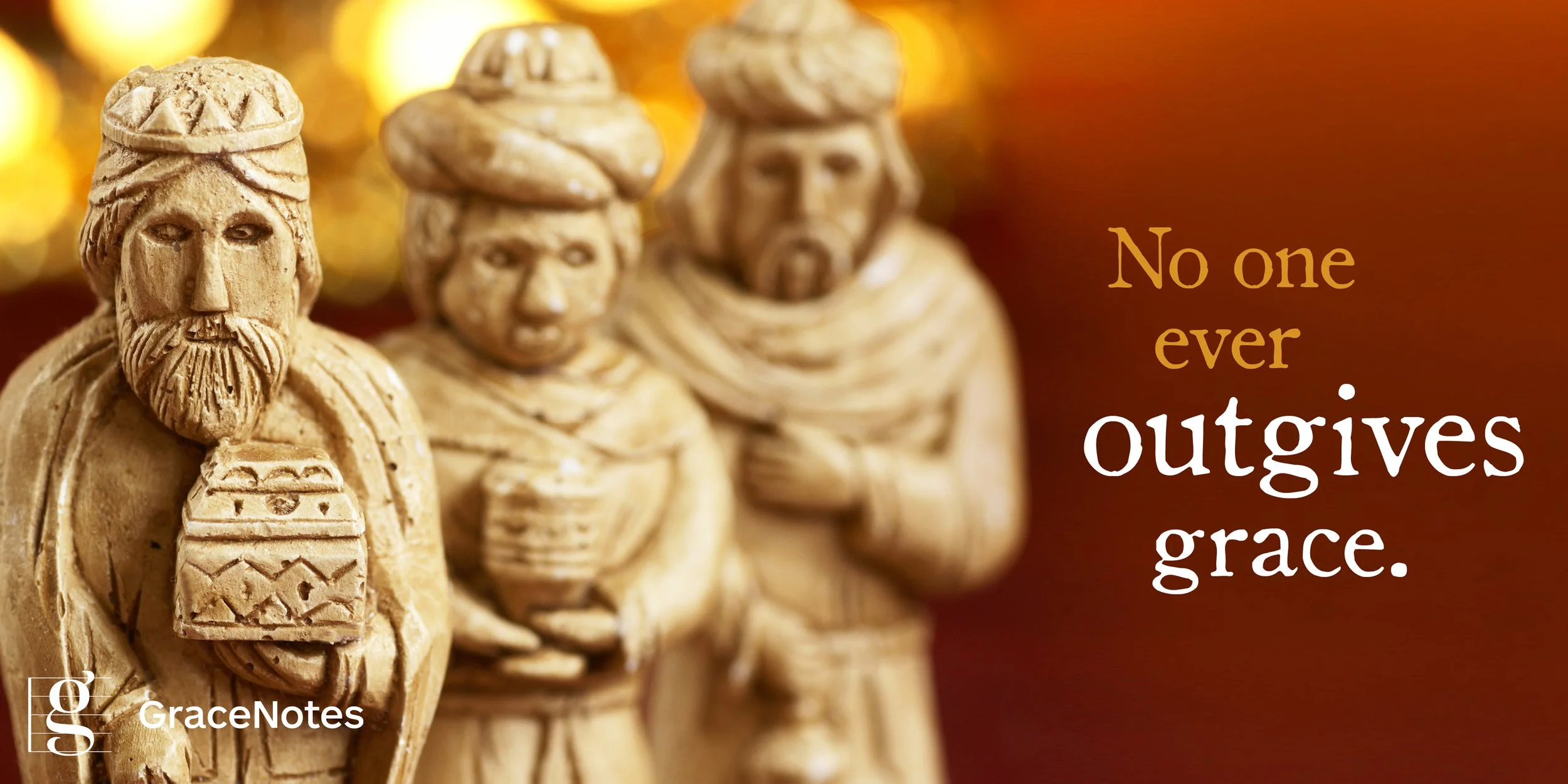
A billion Christmas cards will picture them—these Magi, wise men from the East—with camels, sand, and one bright star.  They traveled once to find a Child: we travel now to share our gadgets, eat too well, and put the fading year behind us.

But theirs’ was not a trip: it was a quest—a deep displacement of their lives because they guessed the Child they sought would heal their wounds; relight their skies; upend what they had previously called “wise.” They staked their reputations, privileges and wealth on finding One whose value system overturns the world.  “He is the source of your life in Christ Jesus, who became for us wisdom from God, and righteousness and sanctification and redemption” (1 Cor 1:30).

“And they bowed down and worshipped Him” (Matt 2:11). Praise was the real gift they brought, for no one ever outgives grace.

Be wise this Christmas, even if you never move a mile. And stay in grace.

—Bill Knott

Comment

Room at the Inn

December 8, 2021

The storybooks of Christmas brim with narratives of hidden visits and secret surveys of our kindness. In our extravagance and parties, Jesus visits those who bear His name disguised as a destitute old man, a homeless young woman, or a lonely child shut out from all the feasting and the revelry.

And we lower our heads, and promise to do better, and actually drop our extra change into the Salvation Army bucket when we leave the stores, laden with our gifts.

But the truest narrative of Christmas is about the gift of presence—God with us, for us—Immanuel who will not let us go. It is the gracious presence of our God we celebrate at Christmas: He walked our streets; He ate our food; He knew hard work and sweat and pain; He celebrated friendship.

Grace is the gift of presence, not of presents. Christ became a human to erase our loneliness, our fear, our dread. “His life brought light to everyone” (John 1:4).

Welcome Him—again—into the inn of your soul. And stay in grace.

—Bill Knott

Comment

The Song That Must Be Sung

December 2, 2021

“Be safe,” uncounted angels urged, and watched with apprehension as the One who made them want to sing stepped down through light years and past planets to a home in Mary’s silent womb. It was the first time they had ever been without His joy. How would His strange descent to live among the broken, tragic, helpless race of humans—letting Himself be born as one of them—affect the ceaseless happiness of heaven?

And so they practiced for nine months, suggesting harmonies so rich and descants they had never tried, to craft a song—the perfect song—for that first night He would appear, an infant wrapped in birthing bands. They found from months of searching just the audience they wanted—sleepy shepherds in the fields—who never had heard music of that quality or kind.

And when the birth had happened, when months of pent-up chorusing became unstoppably joyous, they burst forth on the hills near Bethlehem: “Glory to God in the highest, And on earth peace, goodwill toward men!” (Luke 2:14) 

Grace was always heaven’s plan: peace and goodwill are what our God has always offered us. Jesus, “the Lamb who was slain from the creation of the world” (Rev 13:8), was first chorused to a flock of shepherds. And the joy of those who sang—and the joy of those who heard—has set our world in motion with the rhythms of His grace.

Be listening for the music as you celebrate His birth. And stay in grace.

–Bill Knott

Comment

Simple Gifts

November 23, 2021

If everything is owed to us; if every stream should flow toward us; if we imagine we must regularly be served—there will be nothing to be thankful for. And we will go our careless way to dominate, control, abuse.

But if our lives are really gifts; if every breath is one more grace, then we are not what we achieve, but actually, the sum of all that’s given us.

And we grow grateful for things great and small—for vast, majestic sunsets and for sweet warblers singing in the yard. We see the gift in toddlers’ smiles, and relish simple, joyful laughter. We savor food, remembering the many hands who served and toiled to bring this gift to us. We turn to colleagues and to friends with words that warm them, fill their hearts: “Thank you for the gift you are. I am so blessed to walk with you.”

And if we live in faith, we turn to God and say from what is deepest in our lives—"Unseal my lips, O Lord, that my mouth may praise You” (Psa 51:15). “Let all that I am praise the Lord; may I never forget the good things He does for me” (Psa 103:2).

All gratitude is born in grace, and sees the world through grace-filled eyes. “Praise God from whom all blessings flow.”

Embrace what has been given you. And stay in grace.

—Bill Knott

Comment

A Present Help

November 18, 2021

Where is God when it hurts?

The question is painfully familiar. In every moment when we suffer, we raise our tearful eyes to heaven and ask what all this pain accomplishes.

Will warring nations come to peace because the children starve? Not likely. Will all the daily indignities of living without water and without wealth adjust the fairness of the planet? Not on any planet we know. Will sleepless nights and searing pain ensure some future happiness? There are no guarantees.

And does God know how much we hurt when bodies ache and hopes fall flat? “Because God’s children are human beings—made of flesh and blood—the Son also became flesh and blood. For only as a human being could He die, and only by dying could He break the power of the devil, who had the power of death” (Heb 2:14).

Jesus is God’s answer to the riddle of our pain. The One who made the universe came down to walk our roads and eat our food and feel our loss and cry our tears. He stands beside us; with us; on our side. Grace is God’s presence in our loneliness. 

“Whoever has the Son has life” (I John 5:12). Meaning will yet rise from all this broken ground.

So stay in grace.

Comment

Looking for Safe

November 10, 2021

Safe.

Perhaps you mean a metal-banded box, a vault—a walk-in, high-tech cave where wealth is stored.

Perhaps you mean a spot on earth where threats are temporarily gone, where you can stretch out on the grass, fearing neither man nor beast.

Perhaps you mean a chosen friend, a spouse—a person who will hear your deepest hurts and never leave you by yourself.

You surely mean the covenanted God who is far bigger than our brokenness, our sin—who gathers up and fathers out to all who choose His open arms. “He has removed our sins as far from us as the east is from the west. The Lord is like a father to His children, tender and compassionate to those who fear Him” (Psa 103: 12-13). 

For all His untamed love and unchecked power, our God is deeply and forever safe. “He never changes or casts a shifting shadow” (James 1:17).

Come home to safe. And stay in grace.

—Bill Knott

Comment

Trustworthy News

November 3, 2021

Beyond the screaming headlines; beneath the pundits’ withering analysis; above the daily outrage of our inhumanity to each other, there is a ceaseless broadcast of good news that outlasts every news cycle.

“For this is how God loved the world: He gave His one and only Son, so that everyone who believes in Him will not perish but have eternal life” (John 3:16).

Unlike so much we count as “news,” there’s nothing fake about it. No inflated facts or twisted meanings here:  this is the calm, eternal truth about a God who won’t stop loving us, even when we’re most unlovable.

And on that day when this amazing news grabs your attention like headlines set in four-inch type, it will bring meaning, warmth, clear light and color like no blog or newsfeed ever has.

You are loved, and not just when your hair is combed and you’ve been living in between the lines. You are cherished by the God who welcomes prodigals back home, who goes in search of wayward sheep, whose “steadfast love endures forever” (Psalm 118:1).

Grace is the news we cannot live without.  Write it somewhere on your walls today.

And stay in grace.

Comment

The Measure of Forgiveness

October 27, 2021

The first time we forgive a galling wound, we seem all noble, elevated, full of moral worth. Given how superior we feel, forgiveness seems its own reward.

The second, third, and fourth occasions remind us that forgiveness doesn’t always change the one who angers or offends us. The callous and insensitive may continue just as they were.

About the seventh time, we feel like fools—like 12-year-olds who discover Santa Claus was never real. Why should we keep forgiving when wounding doesn’t stop? Isn’t there a cut-off point when injuries continue? “‘No, not seven times,” Jesus replied, “but seventy times seven!’” (Matt 18:22).

Forgiveness isn’t asked of us so we may feel wise and worthy. Forgiveness is cross-bearing, following Jesus deep into the world’s pain because this is the way God loves, even for the stony and hard-hearted. How many of us would be in grace if Heaven had drawn the line at seven, and left us to our fate thereafter?

The apostle Paul, who was so much forgiven and thus called to forgive so much, once wrote: “Be kind to each other, tenderhearted, forgiving one another, just as God through Christ has forgiven you” (Eph 4:32).

Keep praying for the grace to keep forgiving. And stay in it.

—Bill Knott

Comment

Grace and Truth

October 21, 2021

“This is my faith,” we proudly say, and point to doctrines, dogma, sacred books. “These I believe,” we chorus as we sit in church, surrounded by the arsenal of arguments built up to counter unbelief.

But what is faith at 3:00 a.m. when worries gather in the dark like spiders on the ceiling?  What is our trust when feverish loved ones groan and fret, and we feel helpless to relieve their pain?

The heart of faith is trusting in God’s unrelenting love, much more than lining up beliefs or getting answers to our prayers. To be assured of His affection—to know His hand on us, His salve for all our wounds, His quiet but all-kindly grace—this is the bond that makes faith powerful and real. “Be sure of this,” Jesus says. “I am with you always, even to the end of the age” (Matt 28:20). Christ is never absent.

The truths we teach are, at their best, descriptions of our trust in grace.  The love we never earned and don’t deserve is lavished on us just because God’s heart is love. 

When we trust deeply, we speak well of God:  we tell God’s truth.  So stay in grace.

–Bill Knott

Comment
Oct15-1000x500.jpg

Grace and Silence

October 14, 2021

You know the moment—that instant when your heart hurts terribly from loss or grief. The air seems heavy, hard to breathe. Your mind crawls backward in the dark.

And blessedly, you may also know that moment when a wise friend, often without words, reaches out to hold you, fold you while you grieve.

That grip is grace, made real because the love and reassurance are real. It doesn’t yield in fine-tuned explanations or hang on eloquence. Sometimes the kindest comfort is the silence shared with one who will not let you go.

At its most basic level, the grace of God does not rely on words. The psalmist sang: “You have no equal. If I tried to recite all Your wonderful deeds, I would never come to the end of them” (Ps 40:5). The fact of Jesus, sent to us before He learned to speak a word, is proof enough that grace is first companionship—the knowledge that we’re never left alone, abandoned, or unloved. The wordless Word of God gave witness of the Father’s love before He ever preached or taught or healed our wounds

“He Himself was before all things. And He holds all things together” (Col 1:17)—including us.

 Stay where you’re loved. And stay in grace.

–Bill Knott

Comment

Persistent Grace

October 7, 2021

We measure almost everything in life by big moments: “The day I got married.” “The week I started the new job.” “That instant on my first skydive when I jumped from the plane.”

Memorable as they are, big moments aren’t the real substance of our lives. It’s years of staying married that add value; the honest work that yields satisfaction month by month; the friends who walk with us across the years—who share the “ordinary” days.

The life of faith is like that too. It’s the dailiness of prayer that builds our joy and stamina—the hours of deep openness when “the love of God is spread abroad in our hearts” (Rom 5:5). Trust is built by time and distance shared. A thousand miles of undramatic journeys with Jesus are worth far more than brilliant, blazing moments.

“I have fought the good fight,” the apostle Paul told us. “I have finished the race, I have kept the faith” (2 Tim 4:7).   Paul knew that there is grace at every marker, every signpost, every crossroad.

Keep running—or walking—with Jesus today. And stay in grace.

–Bill Knott

Comment
Oct1-1000x500.jpg

Unstoppable

September 30, 2021

“God is always disappointed with me.”

It’s the mumbled sentiment of many who aspire to a higher, wiser life. We know our failings far too well: we tell half-truths or flat-out lies; we use our power to dominate the weak; we abuse our bodies, as if they really were our own.

And we assume that God is always studying the gap between His law and our performance. Even on our best days, we don’t reach our own half-hearted expectations, never mind His call to holy living. And so we think our failings keep Him at long distance—continually frustrated with us.

But the gospel says God loves us differently. “For God was in Christ, reconciling the world to himself, no longer counting people’s sins against them” (2 Cor 5:19). Even when we lapse into our habits of shame and self-loathing, His attitude toward us remains unchanged:  “God sent His Son into the world not to judge the world, but to save the world through Him” (John 3:17).

 “By grace”—by God’s unyielding affection for you—“you have been saved through faith, and this is not your own doing; it is the gift of God” (Eph 2:8).

 You cannot earn the Father’s love. You cannot lose the Father’s love.

So stay in grace.

–Bill Knott

Comment
Sept24-1000x500.jpg

Always on My Mind

September 24, 2021

Sometimes we have to choose to remember the good things.

So much of daily life is, as we say, “taken for granted.” We assume when we go to bed that our eyes will open in the morning. We don’t worry whether the car will start in the morning. We live our seasons believing there will be enough sun and rain to grow the grass and water the trees. Nothing out of the ordinary here.

But the Word of God urges us to actively remember that none of these things is guaranteed: each is the Father’s loving gift. When our happiness increases, His joy overflows. “Bless the Lord, O my soul,” the psalmist reminds himself, “and do not forget all His benefits—who forgives all your iniquity, who heals all your diseases, who redeems your life from the Pit, who crowns you with steadfast love and mercy” (Psalm 103 2-4).

It’s easy to take even amazing things for granted—like forgiveness, and healing, and grace. And while He is no less God whether we remember Him or forget His goodness, the choice to celebrate His consistent kindness opens the door to abundant living.

God is both very great and very good. His power—His rulership—is matched with tenderness and vast affection for us. Take what He has granted. Choose gratitude.

And stay in grace.

–Bill Knott

Comment
Sept17-1000x500.jpg

Regifting Grace

September 16, 2021

“Love your enemies.”

It’s one of Jesus’ best-known statements—and one of the most misunderstood. The mere mention of those who hurt us, slandered us, or victimized us uncovers all our buried helplessness and anger. Our memories work too well: we can’t summon the will to overlook the painful past. The thought of one day loving those who wounded us seems just another of faith’s impossibilities.

And so we need a power greater than ourselves—which is just what we have received: “God’s love has been poured into our hearts through the Holy Spirit which has been given to us” (Rom 5:5). Only the gift of supernatural grace—the kind the Father has shown to us “while we were still sinners” (Rom 5:8)—can ever move us to reimagine our enemies as friends: “See what love the Father has given us, that we should be called children of God; and that is what we are” (1 John 3:1).

Our enemies are just as fully loved by God as we are. When we receive His gift of love, we learn, in time, to gift it on to them. Grace is this angry world’s best hope for healing.

So stay in grace.

—Bill Knott

Comment
Sept10-1000x500.jpg

The Origin of Forgiveness

September 8, 2021

It’s the fiercest rule of our culture:  the greater the injury—the deeper the wound—the less likely that forgiveness will ever—ever—be offered.

When a friend forgets a lunch appointment or a colleague fails to meet a crucial deadline, we find a grudging grace to overlook the infraction. But if the angry words are public; if the damage done is measured in broken buildings or broken bones, our interest in forgiveness disappears.

We are so fortunate that God’s ways aren’t like ours.  According to the Scriptures, we’re all complicit in the greatest injury to God the world has ever devised—the crucifixion of His Son.  It was our sins—large and small, deliberate and impulsive—that whipped and beat Him, drove the nails, and pushed that thorny crown on Him.  We mocked and taunted Him as He hung dying.

And yet, “God was in Christ reconciling the world to Himself, not imputing their trespasses to them, and has committed to us the word of reconciliation” (2 Cor 5:19).  Amazingly, “God did not send the Son into the world to condemn the world, but in order that the world might be saved through Him” (John 3:17).

Forgiveness flows from God’s amazing grace.  We first receive it; then practice it; then glory in it, for we are saved by it.

So stay in grace.

—Bill Knott

Comment
← Newer Posts Older Posts →

Latest Posts

Featured
Mar 28, 2018
SURPRISED BY GRACE
Mar 28, 2018
Mar 28, 2018
Featured
Mar 28, 2018
THE BREATH OF GRACE
Mar 28, 2018
Mar 28, 2018